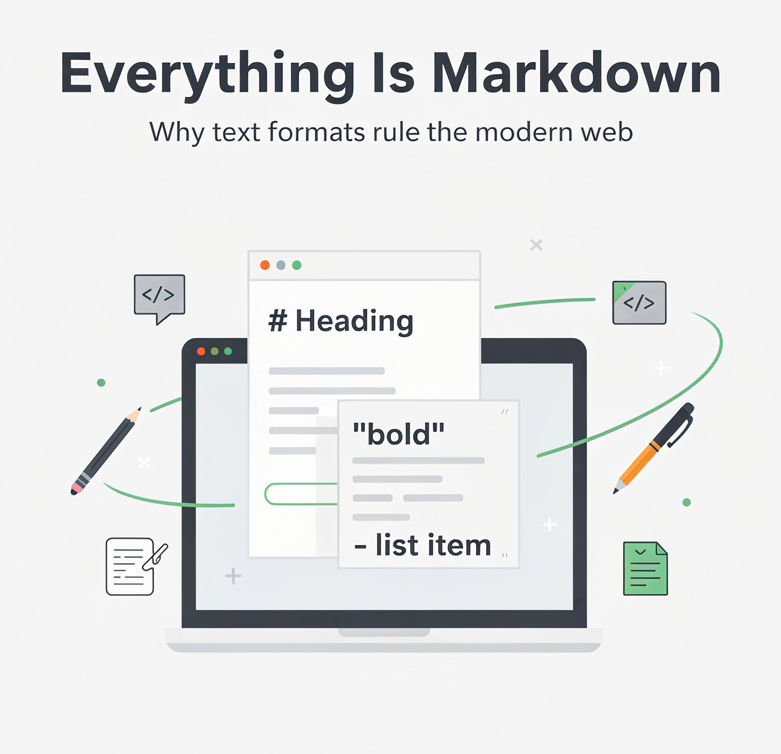
Generated with fal.ai (opens in a new tab)
If you’ve typed bold in Slack, written or read through a README on GitHub, or asked and AI chatbot like ChatGPT a question today, you’ve used Markdown.
I’ve been deep in research mode lately (like, lots of sources deep), and I stumbled on something that completely shifted how I think about the format I’ve been using for years without really thinking about it.
Read on here (opens in a new tab) if you aren’t a Medium member.
Markdown turned 22 this year. And somewhere along the way, it became the invisible operating system for how we write, collaborate, and talk to AI. I’m talking from Agents, to Skills to Prompts and now Soul and Memory, everything is Markdown or in Nigerian pidgin, everything na Markdown.
The Invisible Takeover
Here’s what blew my mind. You’re probably using Markdown right now without even realizing it.
When you type:
-
# Headingin Notion -
**bold**in Discord -
Bullet points with dashes in Slack
-
Code blocks with triple backticks anywhere
That’s Markdown. It’s just… everywhere. And it’s been quietly eating the world.
The numbers are wild:
-
Stack Overflow’s 2025 survey? Markdown is the most admired documentation tool for three years running
-
Over 80% of GitHub projects use it (that’s 800 MILLION repositories, give or take)
-
Teams using Markdown workflows see 40–60% higher documentation efficiency
But here’s where it gets really interesting for 2026.
Why Markdown Won
Markdown wasn’t technically superior. reStructuredText had better features. AsciiDoc was more powerful. Textile had nicer typography.
So why did Markdown win?
Three reasons:
-
It’s “good enough” for 90% of use cases. Perfect for READMEs, docs, and notes. The common case beat the edge case.
-
GitHub happened. When GitHub chose Markdown, it became the default language of developer collaboration. Network effects did the rest.
-
Humans AND machines can read it. This one’s the killer. HTML is machine-first. Plain text is human-first. Markdown is the bridge.
The 2026 Inflection Point: AI Changes Everything
This is the part that made me sit up straight.
Traditional search is dying. Gartner predicts a 25% drop in search engine volume by 2026. ChatGPT has 800 million weekly users. 60% of Google searches end without a click.
And here’s the catch. ChatGPT, Claude, Gemini, and DeepSeek all output Markdown by default.
Not HTML. Not JSON. Markdown.
Why? Because when AI agents crawl your content, they need efficiency. HTML is bloated. Markdown is lean.
The numbers tell the story:
-
Cloudflare launched “Markdown for Agents” in February 2026. It converts websites to Markdown and achieves 80% token reduction
-
In the same month, Laravel Cloud launched Markdown for Agents (opens in a new tab), allowing Laravel applications to serve a Markdown version of a page when requested by AI agents instead of the traditional HTML response and more and more cloud providers are looking to roll out this feature.
-
The
llms.txtstandard (think robots.txt for AI) has grown 1,800% in the past year -
Companies optimizing for answer engines (AEO (opens in a new tab)) are capturing 3.4x more visibility
In a nutshell, if your content isn’t human-first or Markdown-friendly in 2026, AI agents might not find it.
What This Means for the Rest of Us
For developers, this is old news lol. We’ve been living in Markdown for years.
But for my guys who are:
-
Content creators, now is that time for your CMS to be Markdown-native
-
Marketers, AEO is the new SEO in 2026. Answers, not Search
-
Product teams, docs-as-code workflows aren’t optional anymore
The shift is real. iA Writer, Obsidian, Notion, Craft, they’re all built on Markdown. Apple even added native Markdown support to iOS 26 Notes.
So What?
I’ve been thinking about this because it connects to something I’ve been building: PromptDeck (opens in a new tab), a Laravel package for managing AI prompts as versioned Markdown files.
The insight is simple: if AI speaks Markdown, and humans write Markdown, then your prompts, the instructions that shape how your AI-native app behaves should probably be Markdown too.
But that’s another post available here (opens in a new tab).
For now, my point is, Markdown isn’t just a developer tool anymore. It’s infrastructure.
And like all good infrastructure, you don’t notice it until it’s not there.
I dug through 20+ sources for this. If you want the full research rabbit hole, happy to share. Otherwise, next time you type **bold** in a message, smile knowing you’re part of the quiet revolution.